I need more chard!

New leaves from Rainbow Chard are almost too pretty to eat. Almost.

We’re eating chard (Beta vulgaris cicla) faster than it’s growing in my garden, despite the fact that I have two staggered plantings. It’s so pretty that I hate to cut it, but it’s so delicious that I can’t help myself.

Chard seeds look large, but the actual seeds are tiny little things inside the pods.

Chard is a vegetable in the genus Beta, and like beets, there are multiple little seeds within what looks like a big, bumpy seed. When you plant one of those big seeds, you will get up to five plants growing from it. They will need to be thinned. Seeds will last five years or longer if the seed packets are kept cool and dry.

Chard, beet greens and spinach are similar. Wild beets (Beta vulgaris maritima) grow along the coasts of  W. Europe, N. Africa and Asia. They were primarily domesticated for their leafy tops. Romans developed a variety of beet with large red roots in the early Christian period, which were referred to as Roman Beets during the late Middle ages. 

Chard grew in the fabled hanging gardens of Babylon and was cultivated by early Greeks.  During their military exploits, Romans introduced chard to central and northern Europe. Chard spread to the Far East in the Middle Ages and was in China by the 17th century. 

Spinach (Spinacia oleracea), a close relative to chard and beets in the family Chenopodiaceae, migrated in the opposite direction in comparison to beets and chard. Spinach was domesticated in southeast Asia, and made its way to Europe during the Middle Ages. Early colonists brought spinach to the New World. But enough plant history. Back to the present day.

These chard seedlings will become microgreens soon.

During a heat wave this summer, a couple of my chard plants went to seed. As I am the world’s laziest gardener, I ignored the two plants that bolted and let the seeds mature and fall where they may. The result is that patch of overcrowded seedlings above. I’ll harvest them for use in salads as microgreens. I really don’t want to save the seeds from those plants, as they weren’t my best chard. But the microgreens will be tasty in a salad for Thanksgiving dinner.

Rhubarb chard has deep red stems and dark green and burgandy leaves.

My favorite variety of chard is rhubarb chard, which I think has an unfortunate name. Actual rhubarb (Rheum rhabarbarum) leaves are poisonous because they contain too much oxalic acid to be edible. We only eat the stems of rhubarb, and avoid the leaves. Rhubarb chard is another story. I think that there is a movement afoot to call it ruby chard, and that’s a good move.

But both the stems and leaves of rhubarb/ruby chard and all other chards are edible. The leaves of chard are used like spinach, while the stems can be cooked like celery. If I’m making a stir-fry with chard, I add the chopped stems to the skillet along with the onions and garlic, then add the sliced leaves near the end of cooking. The leaves only need to be cooked enough to wilt them. Young leaves don’t need to be cooked at all and can go straight into a salad.

Stems of rainbow chard come in shades of red, orange, and yellow.

My second favorite variety of chard is rainbow chard. The leaves seem to be a bit more tender than those of rhubarb/ruby chard, and the colors are gorgeous in the garden. But I’m partial to the deep red and burgandy of rhubarb chard.

Packets of chard seeds

Two other varieties that I’ll be planting soon are Lucullus shown on the left above, and Fordhook Giant, an heirloom variety from Botanical Interests. Note that the seeds from Botanical Interests are organic. I look for organic seeds whenever I can find them, because whereever those seeds were grown, the insects were safe, and the soil was being managed properly with addition of compost instead of chemicals.

Last night, we had chard cooked Sicilian style, one of my favorite ways of cooking it. I chopped half a red onion and sauteed it in olive oil along with some crushed garlic. If I’m using the stems, I add them at this step. After the onions are translucent, I add the chard leaves, which I had sliced crosswise into half inch slices. I put the lid on the skillet and sauteed until the leaves were wilted. Salt and pepper if you wish, and/or add a dash of crushed red peppers. Add a splash of good vinegar (I used basalmic vinegar last night, but sometimes I’ll use pear chardonnay or citrus champagne vinegar), stir, cover, and steam for another couple of minutes. Serve with shaved or shredded Parmesan cheese on top. Delicious!

(To read more of Lou Murray’s environmental writing, see her weekly column, Natural Perspectives, in the Huntington Beach Independent at www.hbindependent.com/blogs_and_columns/)

Posted in Uncategorized | Tagged , , , , , , , , , , , , , , , , , , , , | 5 Comments

Eat locally grown heirloom vegetables and heritage breeds of livestock

I’ve just updated my “useful links” section of the sidebar with links to three websites that I hope will be life-changing for you: American Livestock Breeds Conservancy, Local Food, and Slow Food.

American Breeds Livestock Conservancy is dedicated to the preservation of heritage breeds of livestock

These sites are dedicated to some aspect of healthy, old-fashioned food, whether it be heritage breeds of livestock, heirloom vegetables, buying food locally, or preparing food the slow, old-fashioned way.

Local Harvest is a good source for meat, produce, and Community Supported Agriculture shares

Slow food is the opposite of fast food. Instead of grabbing a mass-produced product that is the same all over the world, search out regional foods and savor local cuisine. Slow food means taking the time to cook things from scratch rather than buying prepackaged, prepared foods. Vegetable gardeners are the ultimate slow food aficionados.

For those living outside the US, check out Slow Food International.

The odd thing about heritage breed livestock, heirloom vegetables, and local cuisine is that to save them, we must eat them. I grow many varieties of heirloom vegetables in my garden. Heirloom vegetables are open-pollinated varieties that have been passed down for generations, not hybrids that won’t breed true the next generation.

A variety of heritage breed turkeys are available at Rainbow Ranch Farms in San Bernardino County, CA

Vic and I have purchased heritage breed turkeys for Thanksgiving from Rainbow Ranch Farms. We’ve had free-range Narragansett and Broad-breasted Bronze turkeys, straight from Xenia, the farmer who raises them. I found her through localharvest.com. I visited her farm and saw that it was clean and that the birds were raised in a healthy, natural style. While these turkeys were expensive, they really had superior flavor, far better than the turkeys we usually get in the local grocery store.

Border Leicester lamb

Vic and I bought a heritage breed lamb a couple of years ago from a farmer in San Diego. We found him through localharvest.com as well. I visited the farm and saw that the lambs were clean and well-cared for, and then picked out my lamb from among several heirloom breeds. I chose a Border Leicester, a breed raised by Thomas Jefferson and George Washington. I arranged for a butcher to go to the farm to slaughter the lamb and process it. Vic and I split the meat with another couple, as a half lamb will fit into a typical freezer atop a refrigerator with room left over for frozen vegetables, fish, etc. We’re pleased that our lamb was locally raised and didn’t travel half way around the world to get to us.

Here I am with some of our organically grown, heirloom vegetables

We certainly don’t live in a rural area. Far from it. We’re in an urban environment, the greater Los Angeles area. We live amidst 14 million other people. And yet we are able to buy heritage breed livestock straight from the farmer within a 1.5 hour drive, and grow organic, heirloom fruit and vegetables in our yard (front and back). If we can do it, so can you.

(To read more of Lou Murray’s environmental writing, see her weekly column, Natural Perspectives, in the Huntington Beach Independent at www.hbindependent.com/blogs_and_columns/)

Posted in Uncategorized | Tagged , , , , , , , , , | 4 Comments

Building a small water garden

We have a small pond in the front yard that I made about 10 years ago. I dug a hole about 5 ft wide, 12 ft long and from 4 to 18 inches deep. I contoured it the way I wanted, lined it with sand, then covered that with a felt blanket. I cut a thick plastic pond liner to fit, patching the edges together with waterproof kiddie pond sealant.

iris, taro, pond 026

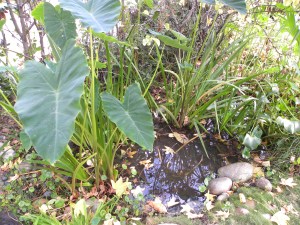
At ten years of age, our front yard pond is heavily overgrown and needs thinning.

After adding rocks and placing the pump where I wanted, I filled it with water, planted taro, water iris, water hyacinth, a couple of dwarf rushes–straight and curly–and some pennywort. Or was it penny royal? Can’t remember. But that was a mistake. The pennywhatever escaped the pond and took over the yard.

Orange County Vector Control supplies us with mosquito fish to prevent mosquitoes in the pond. I’ve put goldfish in it on occasion, but the raccoons just eat them. An alternative to the mosquito fish is spraying with Bacillus thuringiensis israelii, a bacterium that specificaly targets mosquitoes and won’t harm butterfly larvae.

We have enjoyed ten years of looking at our pretty pond, seeing all of the wildlife that it attracts. Our native Western Redbud blooms by it in spring, the irises and water hyacinth blaze blue in the summer, and our liquid amber trees drop their yellow and burgandy leaves onto the reflective water in fall. All year long, our pond is alive with visiting birds, butterflies, dragonflies and other wildlife. 

But that’s the front yard pond. I had a small round pond liner that I bought a few years ago to hold water plants while I was transferring them. I decided to make a water garden out of it as part of my backyard makeover.

hole for pond

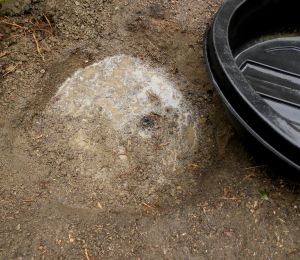
Hole for the pond liner should be just a bit larger than the liner.

Using a prefabricated pond liner was much easier than building my own pond from scratch. First, I dug a hole a little larger than the liner, putting back a little loose soil until the hole was just the right depth. I added water to make the hole muddy so the liner would get well seated.

liner in place

After the liner was in place, I added some water to help it get seated.

Normally I would have planted around the pond first, but because my space in back is so limited, I needed to get the flagstones in place as a first step. The plants would just get squeezed into whatever space was left.

pavers in place

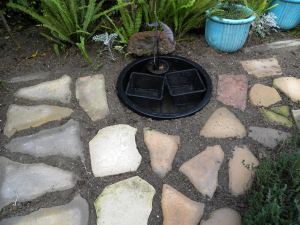
I set pavers around the pond liner, leaving space between them for plants.

The next step was adding some pond planting boxes to the pond, then large gravel or small stones to hold the planters in place. The Garden of Perpetual Responsibility in front provided plenty of rocks.

iris, taro, pond 032 plants in dirt

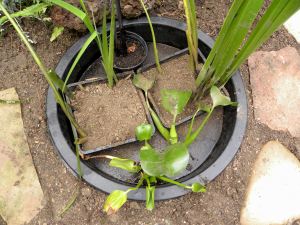
Dirt in the planter boxes provides nutrients for plant growth, as well as holding them in place.

I harvested plants from my front pond, which desperately needed thinning anyway, and set them into gravel in the planting boxes. I also added a pot of a new black taro, Colocasia esculenta “Black Midnight.” Gorgeous plant. I first saw it on the garden tours in Raleigh with the other writers at the Garden Writers Association conference.

I added dirt to within a half inch of the top of the boxes, arranging the plants as I filled. The last step was adding decorative gravel to the boxes and the bottom of the pond. I had a bucket of it in the garage, leftover from the last time I had an aquarium in the house.

035 finished

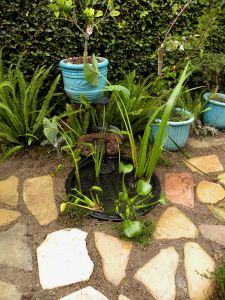
The new little water garden is finished.

The final step was planting thyme, chocolate mint, and sword ferns around the pond, and filling it to overflowing with water. The gravel peeks up out of the water, and will provide perching places for bees and butterflies as they drink from the pond. Now it just needs time to grow. See how easy it is to add a water garden to your yard?

NC 006 waterlilies in pots

Using an above ground sealed container is another way to have a water garden. At Duke Gardens in Raleigh, NC, dwarf water lilies grow in pots.

(To read more of Lou Murray’s environmental writing, see her weekly column, Natural Perspectives, in the Huntington Beach Independent at www.hbindependent.com /blogs_and_columns/)


Posted in Uncategorized | Tagged , , , , , , , , | 2 Comments

Taro–the potato of the Tropics

taro in front pond

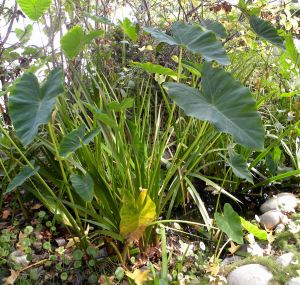
Taro grows in our front yard pond along with iris, wiry rush, water hyacinth, and penny royal.

I’m working on a new pond for our backyard, a small in-ground water garden. One of the plants that I will grow in the pond will be taro or elephant ear (Colocasia esculenta). I have plenty of it growing in my larger front yard pond, and it will be a simple matter to transplant a few small corms.

NC 114 taro leaves

Taro leaves at Plant Delight Nursery in Raleigh, NC

Taro was one of the earliest plants put into cultivation as humans began developing farming practices and domesticating plants. Thought to have been first cultivated in Malaysia and wet tropical India about 7,000 years ago, taro spread throughout the Pacific Basin to China, Indonesia, Egypt, tropical Africa, and eventually the New World in the West Indies where it was grown as food for slaves.

The Maoris took taro to New Zealand, and Indonesians carried it with them to Hawaii, where it is still cooked today into poi. The leaf of the taro, called a luau in Hawaiian, is used as a plate and gives us our name for a Hawaiian-style feast. The young leaves are also edible after 45 minutes of boiling.

taro corm

This is a corm from a young taro plant. They are generally harvested at eight months for eating.

The most often used edible part of the plant is the starchy corm, which is peeled and pounded on a board with a stone until it forms a thick paste. The paste is dried, then mixed with water, kneaded and cooked into poi, a thick gelatinous paste.

Taro may be roasted, baked, or boiled, but I haven’t tried cooking it. Cooking taro is essential as the raw corms contain needle-like crystals of calcium oxalate. Cooking destroys this poisonous skin irritant.

If you’ve cooked taro, I’d like to hear about your experience, how you cooked it and what it tasted like.  Hey, if 100 million people on this planet eat it every day, and 600 million use it as a food staple, it can’t be too bad.

The women of Palau (and many other Pacific Islands) grow taro as a food staple. You can read more about how they cultivate taro at this website. http://www.pacificworlds.com/palau/land/planting.cfm

(To read more of Lou Murray’s environmental writing, see her weekly column, Natural Perspectives, in the Huntington Beach Independent at www.hbindependent.com/blogs_and_columns/)

Posted in Uncategorized | Tagged , , , , , , , , , , | Leave a comment

Our new McCullough electric chipper

I’ve discovered a wonderful labor-saving device that comes in handy when redoing your landscaping. It’s called a husband. Who knew they could be so useful?

vic digs out ferns

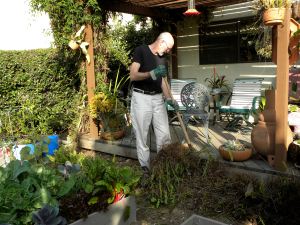
Vic digs out the fern border by the roots.

The secret to getting Vic involved in my backyard makeover was POWER TOOLS. Normally Vic is happy working on his computer or teaching his college classes or out in the field birding. He has little interest in my gardening activities. But when I bought myself a nifty $300 McCullough chipper mailordered from Gardener’s Supply Company, he was right by my side. Which is a good thing, because it’s a powerful little device that neither of us wants the other using unsupervised.

Vic and chipper

Vic puts a leaf bag under the chipper to catch the chippings.

This 14 amp, 1600 watt chipper is a huge step forward in our composting activities, and an integral part of my big chicken plan. I will chip yard waste, put the chippings onto the dirt chicken run, rake them up every week along with the chicken manure, and compost the nutrient-rich chippings. The compost goes back into the garden, a real circle-of-life thing. A bonus is that the chipper is fun to use and surprisingly quiet (unless we’re chipping branches.) Check out the video to see it in action.(Ack, it’s sideways. Can’t figure out how to rotate it. Well, just tilt your head.)

Vic and I took turns chipping the fern tops for the chicken coop. The roots went into the green waste bin for pickup and recycling by the city’s trash hauling service.

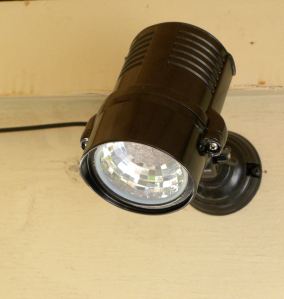
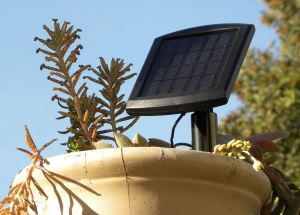
I also ordered a solar LED spotlight from Gardener’s Supply Company and installed it myself on the coop. I screwed the spotlight to the coop, ran the cable up to the roof of the coop, and set the panel on its stake into a potted plant on the coop roof, which is the sunniest spot in our backyard. So easy a grandma can do it. The light turns on automatically at dusk and is plenty bright enough to see any varmits that might be prowling around my hens. Which I still don’t have.

solar light

Solar spotlight in coop lights up the chicken run at night for added security.

solar panel

The solar panel sits on a stake that I put into a pot of plants atop the coop roof.

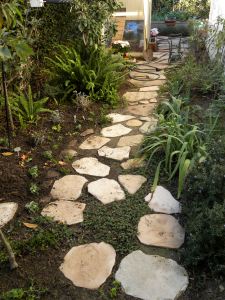
Cluckingham Palace still needs a few tweaks. I’m still working on the flagstone pathways and planting flowers (mums, allysum, nasturtiums, Nemesia, iris, narcissus). I haven’t had time to finish painting the coop or hang the artwork (which is for me to look at, not for the chickens). But the back is really coming along nicely. Soon, soon, soon, I’m gonna get my hens.

revamped pathway

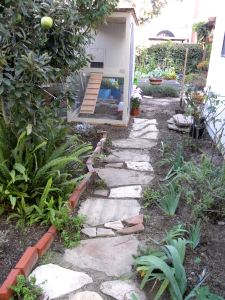
I took out the straight row of bricks, put a bit of a curve into the flagstone path, and planted allysum, nasturtiums, and Nemesia along the path.

(To read more of Lou Murray’s environmental writing, see her weekly column, Natural Perspectives, in the Huntington Beach Independent at www.hbindependent.com, under columnists.)

Posted in Uncategorized | 1 Comment

A Southern California garden in November

I love it that we can garden all year long here in coastal southern California. My summer vegetables may be nearing their end, but the fall vegetables are entering their prime.

coop 015 eggplant

Black Beauty eggplants are still ripening

Although we’re well into fall, I’m going to get one more pot of spaghetti sauce from my Roma tomatoes, and one more cucumber salad from the last cucumber on the vine. I also have hopes for another pan or two of eggplant Parmesan. I have three Black Beauty eggplants in various stages of unripeness, and several Millionaire Japanese-type eggplants ready to pick.

coop 020 Roma tomatoes

A few Roma tomatoes struggle on into the autumn

This has been a banner year for bell peppers for us. For some

coop 021 bell pepper

Black bell pepper

reason, I’ve never been able to grow decent bell peppers. Until this year, that is. I don’t know what the difference is, but we’ve had all of the peppers that we could want this summer–green, red, yellow, orange, and black ones. Beautiful, bountiful peppers. I hope I can duplicate this bounty again next year. I’ve been able to overwinter  pepper plants and have them produce again the next summer as though they were perennials.

coop 024 butternut

Ponca butternut squash

I think I planted my butternut squash too late in the summer. I got only three small butternuts on four vines. The vines are still producing flowers, but I think it’s too late in the season for them to set fruit.

While New Englanders and Midwesterners are putting their gardens to bed for the winter, I’m getting ready to harvest fall crops of cabbage, cauliflower, collards, kale, chard, lettuce, spinach, and other cool season vegetables.
coop 062 bed #2

Raised bed #2 is full of cool season crops like cabbage, cauliflower, leeks, spinace, lettuce and chard.

My fall garden is growing in these nifty new Forever Raised Beds from Gardners Supply Company. They’re made of recycled plastic and wood chips, and look like aged cedar. This is my first attempt at square-foot gardening, and I’m a convert. I’ve never had a vegetable garden as lush as the one above, nor grown as many vegetables in as small a space. I’m sold on square-foot gardening in raised beds.
(To read more of Lou Murray’s environmental writing, see her weekly column, Natural Perspectives, in the Huntington Beach Independent at www.hbindependent.com, under columnists.)
Posted in Uncategorized | Tagged , , , , , , , | 7 Comments

One step closer to urban chickens

Our backyard makeover is progressing, but I’m wondering if it will ever look nice again. It’s a rough work in progress at this point.

backyard makeover

Main elements of three raised beds and herb garden are in place, with more work on the path and new pond needed.

We got our permit from the city to keep hens (YAY!), but I’m still not done with the coop. I had to move a flagstone pathway to make room for the coop, and I’m still resetting the stones. Lots of work remains to be done.

coop

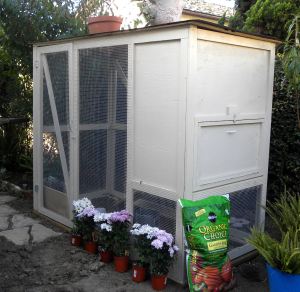
Chicken coop still needs some minor work, but the structure is finished.

I want to make some changes to the coop before we get our hens. The latch that our carpenter put on will be too easy for a raccoon to open, so I’m adding a door latch that varmits can’t operate. I also got a latch and chain so I can partially open the “egg-gathering” door on hot days for increased ventilation. I also plan to lay tile in the floor of the coop (not the run, which is dirt) to make it easier to bleach the floor on occasion.

path

I'm still working on resetting the flagstone pavers.

 I’m shopping for a wooden planter box that I can nail to the side. I’m picturing succulents flowing down from the box, something like burro tail. I plan to make a “green roof” for the top of the coop, and have already begun potting plants to put up there. That area gets a lot of sun and should make a great place for starting seedlings next January.

mission art

The mission at Carmel in concrete

And the coup de grace for the coop (would that be coop de grace?) is some concrete art that I found in our garage that will look perfect on the coop. These pieces are sculptured concrete, possibly poured into a mold, and framed for outdoor hanging. One is of redwood trees and the other is of the Spanish mission in Carmel. They will look perfect hanging on the coop once I get that second coat of paint applied. I mean, really, this is going to be some Cluckingham Palace.

(To read more of Lou Murray’s environmental writing, see her weekly column, Natural Perspectives, in the Huntington Beach Independent at www.hbindependent.com, under columnists.) This week’s column is on our photo club’s trip to Monterey and the agriculture tour. See it at http://www.hbindependent.com/articles/2009/11/06/blogs_and_columns/natural_perspectives/hbi-natural110509.txt)

Posted in Uncategorized | Tagged , , , | 2 Comments

Pumpkins aren’t just for Halloween

 
295 horror pumpkin 2 b&w blue filter
Spooky blue hubbard squash, carved while growing to create scars.

When I was in Monterey last week with my camera club (Photographic Society of Orange County), I stopped by the Earthbound Farm farmstand for an organic, vegetarian lunch at their salad bar. Earthbound Farms was at the forefront of the large-scale, commercial organic produce movement in the early 1980s. They started out with 2.5 acres of organic raspberries and are now the largest growers of organic produce in the US, with 33,000 acres farmed by 150 different farmers. But their little farm stand in Carmel Valley still retains the feel of a family farm roadside outlet.

Earthbound Farm

Earthbound Farm roadside stand is decorated for autumn

pumpkin totem

Pumpkins impaled on a spike made a great totem pole.

Many fascinating varieties of heirloom pumpkins waited for someone to choose them and take them home: Queensland Blues, Jarrahdales, Rouge Vif d’Etampes, Fairy, Long Island Cheese, Kabocha, and of course the standard orange Connecticut Field pumpkins. Surfaces ranged from smooth to warty, with various degrees of ridging, and colors ran a rainbow from pale buff to orange to deep red and even to blues, grays and greens. Shapes varied from round to oblong to flat.

But how many of those pumpkins are going to just get tossed after Halloween? They’re FOOD, for heaven’s sake. The seeds can be salted, roasted and eaten, put out for the birds, or saved for next summer’s garden.

green and white pumpkinsridged pumpkinsThe flesh is what goes into pumpkin pies. I cut my pumpkins in half and bake them, scoop out the flesh and put it through a ricer. I freeze what doesn’t get used right away for pies or soup. At the very least, pumpkins can go into the compost bin instead of the trash can.

Each variety seems to have its own taste. I don’t care for the flavor warty pumpkinsof the white pumpkins. Too anemic in flavor as well as color. I think the taste of the Long Island Cheese or Fairy pumpkins is inferior to the Sugar or New England Pie pumpkins, but taste is a personal thing. Connecticut Field and Howden pumpkins can be too fibrous, although the flavor is fine. Queensland Blues are wonderful to eat, but you need military-grade equipment to cut into their hard shell. I cut my last Queensland Blue into cubes and cooked it in the crockpot along with chunks of grass-fed bison hump from our local farmer’s market, plus potatoes, onions and red wine.assorted pumpkins

If we get our community garden operational by next summer, I finally should have room to grow pumpkins. I’ve been saving seed from Halloween pumpkins for a couple of years now. They’ll last about five years. I also have some seeds of Amish Pie pumpkins from Ferry Morse seed company that I want try. And then I discovered the offerings at Baker Creek Heirloom Seeds. They have a lot of unusual varieties from southeast Asia that could go into soups, stews, pies, risotto, tempura and stir-fries. So many pumpkins varieties, so little space, and only so many summers.267 organic sign

(To read more of Lou Murray’s environmental writing, see her weekly column, Natural Perspectives, in the Huntington Beach Independent at www.hbindependent.com, under columnists. This week’s column is on urban chickens! See it at http://www.hbindependent.com/articles/2009/10/29/blogs_and_columns/natural_perspectives/hbi-natural102909.txt/ It should remain online for 5 weeks.)

Posted in Uncategorized | Tagged , , , , , , , | 2 Comments

Harvesting broccoli and lettuce in Salinas Valley

field of lettuce

Fields of baby lettuce in the Salinas Valley, California

Adding videos to my blog seemed like a great idea. I took some videos in Monterey with my Nikon Coolpix P-90 (great little digital camera) last week, first ones I had taken with that camera. But how to post them?!?!?

WordPress doesn’t accept .avi files, which is what my camera takes. I logged onto the wordpress forum and got my answer. Sort of. You have to upload them to Youtube first. Ack, another thing to learn. All this technology.
     Turned out that was fairly easy, as well as sharing them on my Facebook page (which isn’t public) and Twitter. I did that from the Youtube site. But to insert the videos in my blogs, I had to go to the “insert” section under drafts and click on “video.” Piece of cake.
      Here is a shot of agricultural workers harvesting broccoli in the Salinas Valley. 
 
     I know it isn’t the most gripping film in the world, but it shows how the workers follow a slow-moving tractor, bending and cutting, bending and cutting, then tossing the broccoli up to the people on the platform, who wrap it. Check out the victory dance of the guy on the left in the white sweatshirt as he nears the end of the row and a brief break as the tractor swings to go down the next row.
harvesting Romaine lettuce

Agricultural workers harvest romaine lettuce in Salinas Valley.

Romaine and iceberg lettuce, as well as cauliflower and probably other vegetables, are harvested the same way. They don’t get washed, but are packaged right in the field. We saw all of these things on our Ag Ventures Tour with Evan Oakes (agventuretours.com).
     From the field, the vegetables go into boxes, which go into trucks, which go to refrigerated warehouses. From the warehouses, they go into refrigerated trucks for shipment to distribution points, and thence to other refrigerated trucks and to your grocery store. A LOT of fossil fuel gets burned in the processes of cooling and shipping.
field of artichokes

Field of artichokes in the Salinas Valley

     It is sooooo much better for the environment if you can grow at least some of your own food at home. Even a little bit helps. You can even grow some things in containers. Here in late October, I have bell peppers, chard, cauliflower, cabbage, leeks and salad greens growing in raised beds from Garden Supply Company. I’m growing green onions and bok choy in pottery “color bowls” right now. I also have artichokes, rhubarb and red onions growing in the “Garden of Perpetual Responsibility” and kale, cabbage, chard, collards, and eggplants growing in our front yard by the sidewalk. What are you growing in YOUR garden?

Posted in Uncategorized | Tagged , , , , , , , , , , , , , , , , | 3 Comments

Urban Chicken Wars

It seemed like a good idea at the time. As part of our plan to become more self-sufficient and live sustainably, we decided to get some chickens. (When I say “we”, of course I mean ME. Hubby Vic is a reluctant participant in this project.)

chicken book

Chickens for the Backyard: A beginner's guide

We’re hardly at the forefront of the urban chicken movement, since Sunset and National Geographic magazines, as well as the Los Angeles Times, all had articles on the subject last winter. I began researching the topic, going to www.chickencoops.com to get ideas. I sat down with my co-worker and carpenter friend, Simeon Jasso, to design a custom coop just the right size for three hens.

coop under construction

Simeon is assembling the run for the chickens. The roof will go on later.

Between my frequent out-of-town trips and Simeon’s schedule at work and his callups from the Navy Reserves, it took us many months to settle on a plan and get construction of Cluckingham Palace underway. The coop and run are now mostly finished, with the roof going on this Friday. The entire run is enclosed with half-inch mesh hardware cloth to keep out wild birds and urban wildlife (raccoons, opossums, skunks, coyotes, gray fox, red squirrels, ground squirrels–we’ve got ’em all).

coop interior

The interior of the coop has roosts and nesting boxes, with a door opening to the exterior for cleaning and egg-gathering.

To do this legally, I  needed a Huntington Beach city permit to keep chickens. That cost a whopping $189 (on top of the $800 for the coop, and another hundred or so for a feeder, waterer, carrying case (my husband plans to take a chicken to class every so often for his feather and bird anatomy lectures), etc. At least the city permit is for life, not an annual permit.

our neighborhood

Our Huntington Beach neighborhood has tile-roofed, stuccoed houses with three car garages.

The city planning department sent notices to my neighbors that we planned to keep chickens, and that’s when the war began. Most of our neighbors are great people. But the people behind us have a bark-bark-barking mini-dachsund that has been the bane of my existence for its entire 15-year life. That nervous little dog–who lives outdoors–makes my life a living hell. Naturally, those are the people who are objecting to my chickens–which I don’t even have yet. They’re concerned about the noise. Unbelievable.

my neighborhood

Some houses are one-story and some are two.

The city recommended that I get signatures from those neighbors who don’t object in order to counteract her letter of objection. Our neighbors are a cosmopolitan melting pot consisting of Cuban Jews, Vietnamese Buddhists, Egyptian Christians, Mexican Catholics and a couple of Anglo whatevers. Many of them had parents who kept chickens in the old country. They were delighted to have chickens in the neighborhood. So. No egg on my face.

I’m not sure why my neighbor with the noisy dog got her feathers all ruffled over this, but she’s going DOWN. The yolk is going to be on her. My coop construction and placement are within city code and I’m gonna be getting that permit. I hope. Stay tuned.

(To read more of Lou Murray’s environmental writing, see her weekly column, Natural Perspectives, in the Huntington Beach Independent at www.hbindependent.com, under columnists. Today’s column is on urban chickens! See it at http://www.hbindependent.com/articles/2009/10/29/blogs_and_columns/natural_perspectives/hbi-natural102909.txt/ It should remain online for 5 weeks.)

Posted in Uncategorized | Tagged , , | 12 Comments