
I just returned to Huntington Beach from a fabulous trip to Monterey with my camera club, the Photographic Society of Orange County. We had a great time on our five-day trip, taking photos and seeing the sights.
 I arranged for an agriculture tour for those who wanted to go with Evan Oakes of Agventuretours.com. We thoroughly enjoyed our half-day tour of the Salinas Valley, where most of America’s salad greens are grown. I’m going to get a newspaper column and more than one blog post out of this wonderful experience. Here is info in case you are up that way and want to take a tour.
Ag Venture Tours & Consulting
831-761-8463 Phone

One of the many things that Evan showed us was a field of prickly pear cactus that had 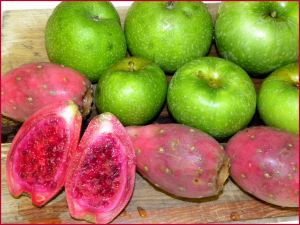 more fruits on them than I’ve ever seen on prickly pear cactus. Evan pointed out that the ripe fruits are rolled to knock off all of the spines before they go to the grocery stores. At a farmer’s market, I touched one and it was as smooth as a baby’s bottom. OK, maybe as smooth as one with a diaper rash, but it was not at all prickly. So I bought four, intending to make prickly pear jelly when I got home.
 I knew I needed pectin, which is found in large quantities in apples, so I picked a half dozen organic Granny Smith apples from my tree in the backyard. I quartered the prickly pears and cut the apples into eighths, cooking them with just enough water to cover until they were really tender.
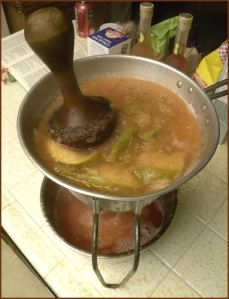 I put the cooked fruit through my colander, which I inherited from my Mom. It must be 70 years old. My original plan was to make jelly, but that would have meant composting all that nice fruit pulp. I decided to make prickly pear/apple butter instead.

Finished apple butter in sterile jars
I cooked the pulp with organic brown sugar and spices (cinnamon, nutmeg, cloves, allspice, and mace) until it sheeted off a spoon, then packed it into sterile jelly jars.
The spices overwhelmed the mild flavor of the prickly pears, but it was fabulous on some toast. I may try more prickly pears, fewer apples, and no spice next time to make jelly. I don’t know though. This fruit butter is pretty darn good.
6 apples
4 prickly pears
water to cover
1.5 cups of organic brown sugar
3 tsp ground cinnamon
1.5 tsp ground cloves
0.5 tsp ground allspice
0.5 tsp ground nutmeg
0.5 tsp ground mace
(To read more of Lou Murray’s environmental writing, see her weekly column, Natural Perspectives, in the Huntington Beach Independent at www.hbindependent.com, under columnists.)
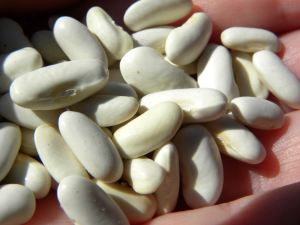 When I was at the Garden Writer’s Association conference in Raleigh last month, I visited the exhibit booth of Baker Creek Heirloom Seeds and was quite impressed with their offerings.
 I took a peek at their website yesterday at
  I requested a copy of their 2010 catalog, but I plan to order some seeds of Asian greens now for fall planting. That’s one of the joys of gardening–being able to grow vegetables that you can’t find in the grocery store.
  Baker’s Creek Heirloom Seeds was started by Jeremiath (Jere) Gettle in 1998 when he was only 17. He had started gardening at age 4 and was making play seed catalogs by the time he was 7. Gettle has a passion for seed-saving and preserving old varieties that might otherwise be lost to the world. He has traveled extensively in southeast Asian and Central America, collecting seeds of unusual varieties of vegetables.
 Vic (my loving spouse) thought it would be a perfect place for a vegetable garden because it was sunny, so I began “farming” it a few years ago. That was right about the time our neighbors to the south planted a solid wall of trees and shrubs in their similar-sized planter.
 I can’t grow root crops here because of the gravel. And I’m tired of spading through that gravel each season. So I have decided to try perennials. I put in some thornless black raspberries last spring. I set them into nursery pots buried in the ground, just so the raspberry vines wouldn’t take over the entire plot. (Ha, like something other than weeds would grow in that garden!) On the spur of the moment, I bought a Victoria rhubarb plant and put that into the ground. They like colder winters than we have here, but I should get at least a couple of years of spring rhubarb stalks out of it.
 I had good luck with an artichoke plant there in the past, so I decided to plant more artichokes this year. I bought three pots, and was surprised to find that they each had two artichoke plants in them. Then I got another surprise. My original artichoke, which I thought was dead, had sprouted after our recent rain.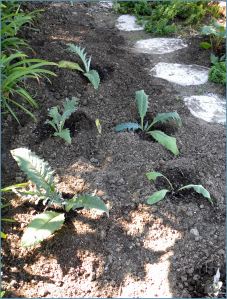

 Our 1750 sq ft house, three-car garage, driveway, deck, patio, and sidewalks occupy most of that 6,000 sq ft. That leaves little room left for food production. But into the remaining space we’ve managed to fit three vegetable growing areas and 21 fruit trees. I chose varieties that would produce fruit at different times of the year, so there is usually something to eat year round from our fruit trees.
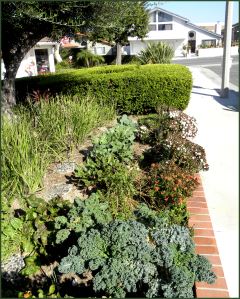 The vegetable garden is another story. I grew most of my plants from seed this year, which is very cost effective. The value of the amount of food that I get from a typical packet is about five times more than what the seeds cost. I focus on heirloom seeds. Unlike hybrid seeds, these breed true and can be saved from year to year. That’s when the real savings kicks in.
 But the peace of mind that comes from knowing that our food is organic and not contributing to the carbon-load of being trucked or shipped from South America? Priceless. And the freshness, taste and unusual varieties? Well, those are reason enough to keep on gardening. Besides, it’s FUN! I’m headed outdoors to plant artichokes and rhubarb.
 Neighboring SEEDS had a similar structure, pictured here.


 Lou Murray's Green World